Showing posts with label weaving. Show all posts

20151231

Pure


The most asked question—and I’m sure other makers get this, too—is “How long did it take you to make this?” I suppose it’s one of those things people are accustomed to asking, like saying “I’m sorry” at funerals or something. The fact is that the length of time it takes to make something doesn’t really tell you anything. The Work says everything.

So let’s just get this out of the way: This weaving project (I’ve been calling it “Pure”) took me six months to complete. That doesn’t mean I was working on this non-stop, it just means that from start to finish it took that long. See? That information doesn’t mean JACK. During the time this was on my loom, I started, completed and sold numerous knitting projects, recycled sweaters, etcetera, you get the idea.


There really isn’t anything all that complex going on in my weaving. I’m still pretty new to the craft, so composition is what I’m really focusing on. I look at the visual elements, and how colors interact with each other to define that composition. That’s pretty much it. In technical terms, this is a plain weave with a few color alternations.

The scale of a piece is something I like to explore in all mediums. Generally, I lean towards light fabrics comprised of finer yarns. Since the sett is so high, minute changes become sharp breaks in the composition. The thin pinstripe wefting is an example of that. I’ve taken these elements a bit further by leaving the ends attached and dangling off the selvedge.

Aside from the straight-forward contrasts and high sett, there are some quadruple strand wefted sections near the center that are barely noticeable. Eventually, these sections will differentiate themselves with their stability while the lighter broadcloth wefts wrinkle around them (or maybe not, who knows).


Overall, the composition consists of an unstoppable deluge of this cool charcoal that borders a desaturated navy, with light gray selvedge that comes in full force at the very end of the weave. This kind of basic two block/two color looks great in monochromes. I like how the charcoal color comes off as blue. I like that it’s faded. You can’t get that kind of ambiguous desaturation very often. Maybe that’s why I like faded blacks and grays so much. They’re ambiguous, and difficult to define.

The yarns:
Cool Charcoal
Recycled from a Gap sweater.
Light Gray Main Color and Light Gray Alternating Wefts section
The armband sections of another Gap sweater I recycled, as well as the seaming thread used on the armbands which was slightly different in color.
Warm Charcoal Block Wefts
The last remaining yardage of the yarn lot.

20150912

Fragments


I don't want to rename this project despite how much I hate the name "Fragments." In part I don't care about names at this point. This was a preliminary exercise at best, a way for me to begin looking at the compositional elements and techniques I wanted to employ. It's a rough draft of what would later become Delete Charlie. However, once all those ideas migrated over to that project, I just put this away, and forgot about it. Then other projects took over, and Fragments was just a pair of handwoven textiles sitting around taking up precious space.

So one of those compositional techniques I wanted to use was this idea of seaming. I really latched onto this idea because it effectively opened up the canvas, but also because there was this sense of randomness which later leads to opportunities for improvisation.


I don't have much control while wefting colors together in a handwoven textile. Keeping a count, and making measurements is all I can do. It's more of a prediction than anything. I'm okay with that. Visually, I want all the weft variations to occur in the middle, and the ends to be as plain as possible. So long as the two pieces are reasonably different outside of that, then it'll be fine.

Once the two pieces are seamed together, there is this sense of displacement created. In effect I'm generating a visual discrepancy by merging the two, then harmonizing the visual whole with sashiko embellishment. The two pieces are already unified in color and texture, but the individual weft compositions are what essentially break the grid. Further, the differences in warp widths add more variation to the visual whole.


In addition to the visual differences, there are some physical discrepancies that occur here. The charcoal gray yarn is a two ply single strand, and the light gray is a thinner two ply that is doubled. While they appear to be the same weight, the light gray is slightly thicker, and therefore wefts itself longer. Ten rows of light gray is longer than ten rows of charcoal by about a millimeter. On long stretches of light gray, that length discrepancy becomes significant, and that is where the sashiko comes into play. By using uniform running stitches, the fabric is gathered, similar to smocking. The resulting texture is what takes this composition to another level.


In general, this piece was more about the finishing than the actual loom work. I spent more time on seaming and embellishment than weaving. As I was working on it over the past few months, I came to realize how much I liked this. The seaming, though mundane, felt strangely satisfying. The sashiko stitching became very meditative. I found myself looking forward to working on it. As I look back on all the progress I've posted to my Instagram feed about this project, I'm a bit surprised to discover that it is the single most posted project to date. I was going to post a recap of all of them, but there are just too many images. But hey, I'm sure you've all seen them already, right?

The yarns:
Charcoal gray cotton blend by DKNY
Light gray cotton blend by Old Navy
Black silk seaming thread by Banana Republic

Oh, and my loom:
Emilia 19" rigid heddle loom by Glimakra


20150320

Light Beats


It's been three weeks since I finished this piece, but weaving is still so new to me that I've been reluctant to model the final piece. After it was done, I kept it within reach so that I can wear it every now and then. In hindsight, the reluctance was irrational. I thought that the delicate openness would somehow distort into a tangled mess, or that it would somehow crumple like a vampire lit by sunlight, or tear apart like wet paper. That's how I feel about the things I make sometimes.


Yet the structure of this piece has remained as it was after cut from the loom and washed. The varying density of light beats and high tension have remained fixed in their respective sections. I'm guessing that this is due to the yarn structure. The blue is a lace weight cotton comprised of 60% cotton, 29% nylon, and 11% wool. That synthetic content added weighted drape to the original sweater. It may have contributed to it's elasticity as a warp yarn, but that's just a guess.

Adjacent sections of varying openness will likely ease themselves into place as the piece is worn, but then they may not. I suppose I waited to post about this piece for that reason as well. I wanted to let it break itself in, open up. Let it become part of my life.


Here are the yarns used in this project: Blue, Gray Weft, and Gray Selvedge.

20150202

Delete Charlie


Sometimes when I start a project, I'll blurt out my idea just to get it out of my head, and into fruition. Sometimes it's spot on in one try, and other times I have to kill the first idea and try again. That's how the creative process works. In order to create a strong body of work, you have to learn to kill your babies, specifically the weak ones. But doing the work, making that first attempt at creating what you know might die is a necessary part of the process.

So the first idea was to knit three narrow bands of garter stitch, and then whip stitch them all together. This is still a pretty solid direction, but after working on it for months, I realized how much I hated the monotony. This first version of this project was the only knitting project I had going for a while, despite the fact that I needed to be knitting hats for my Etsy shop. I was calling it "Fragments" at the time, stupid name, really.

During this time, I was also learning how to weave on a rigid heddle loom that I purchased recently. I was torn. Do I jump into a full-blown weaving project so soon after having learned the most elementary basics of plain weave? Or do I continue to bang out weaving samples parroted from Jane Patrick's book? So boredom with my first idea, and an itch to weave a twelve foot warp lead to what this project turned out to be.


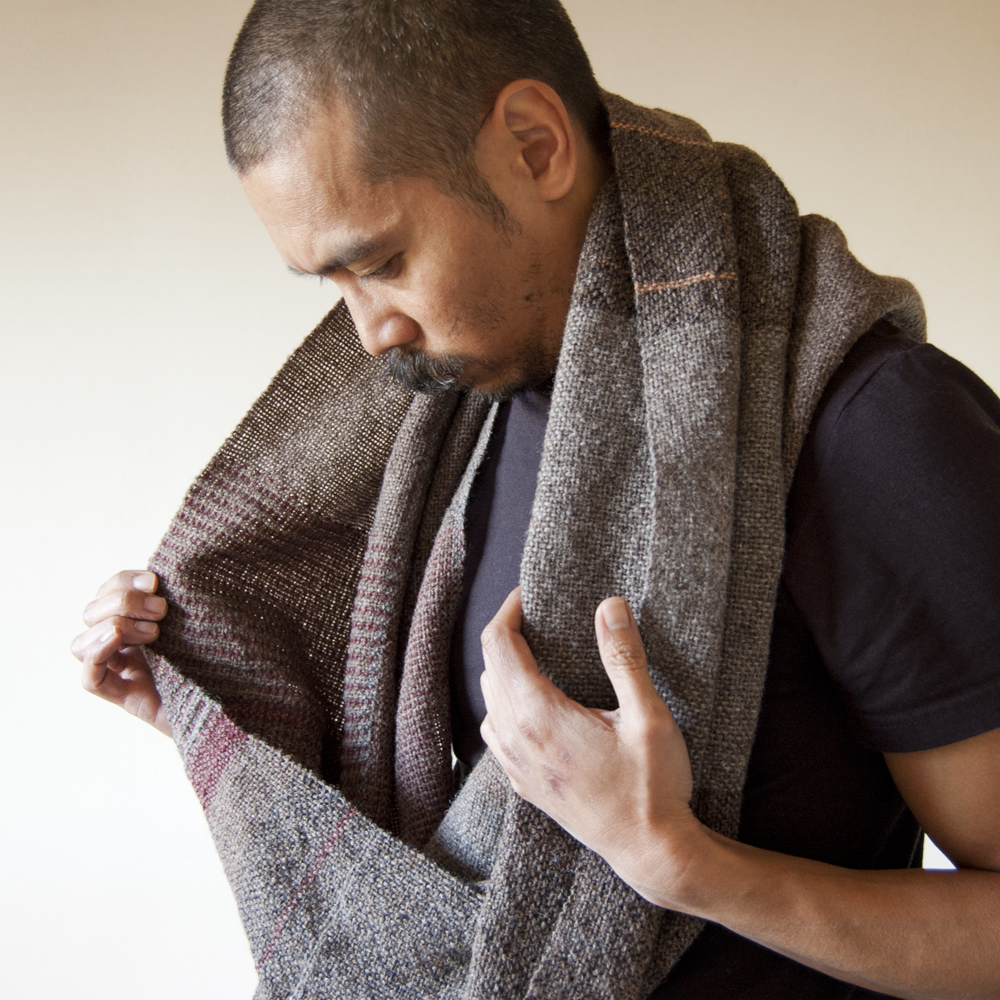
And what it turned out to be is an iteration of my stash-busting series, Delete. Being the third, it is designated Delete Charlie. If you're curious, here are Delete Alpha and Bravo. The twelve foot warp I just mentioned barely diminished, shrinking only six inches to a completed length of 11.5 feet (350.5 cm). The width relaxed down to about 11 in (28 cm).

I don't remember where I mentioned this, but I don't like little tiny scarves. I don't see the point. By tiny, I mean short. This is a very subjective term, I realize, but to me the term 'short scarf' refers to anything that is under five feet (152 cm) or so. I want to drown in it. If I neglect to wrap it around me enough times, I want to be penalized by having it scoop under my feet, and trip me. But this, of course is not that type of long scarf. It could have been, but it's not.

Since this is a circular scarf, the winding around has already been taken care of. I got the idea for this peculiar spiral construction from a bag I saw on SriThreads. I'm intrigued by diagonal geometry in general, and this bag has popped into my head (and my Pinterest feed) on a few occasions. The technique is pretty straight-forward, but the tricky part was determining a reasonable width for the resulting cylinder. In this case, the circumference is about 55 inches (140 cm). I achieved this by modifying the angle to a length that was half of that. It ended up being about 28 inches (71 cm) which is slightly longer to account for some shrinkage.


As far as the seaming goes, I attached selvedge loops to one another as if to introduce a new warp yarn. This created some interesting discrepancies where selvedges of alternated colors met stripe sections along the spiral seam. Because of the slight differences in yarn sizes, there were differing weft heights being joined together. This resulted in portions that looked like deflated balloons, or under-stuffed pillows. I remedied this with little armies of running stitches. It's reminiscent of English smocking, and Japanese sashiko, and the visual texture it created really brings the beauty of plain weave up (quite literally, I suppose) to another level.


I look back on the knitted thing that this piece could have been, and it's so boring in comparison, so ugly. That first idea had to die in order for this one to live. Being creative means having the ability to generate so many ideas that killing some of them is only natural. Additionally, it would be quite arrogant to presume that every idea is good enough to keep. Coming up with bad ideas is just as important as coming up with the good ones. It's all part of the process.


Here are the yarns I used: Brown, Grey, Black/Bronze, Red, and a very brief appearance of Orange.