20150814

Shear Alpha Five


In the previous version's blogpost on Shear Alpha (Four), I didn't really talk about this design, and how it has changed over the course of it's life. I think it's important to shed some light on that because it touches on some aspects of my creative process. A lot of knitters assume that because I design my own patterns, that there are downloadable versions of them out there, but there are not. I don't write knitting patterns, and I am not a knitwear designer. I am a designer. Knitting is just a medium in which I demonstrate my creative process.

With that being said, each hat represents a step forward in that process. Primary designations differentiate the shapes. Shear is the parallelogram. Secondary designations--denoted by NATO phonetic alphabet--refer to variations in stitch compositions that define the shapes, and clarifications to the structural mathematics. Tertiary designations track changes in yarn and color using a number. Every hat I have made represents an exploration of this process.


So let's talk about the Alphas. They essentially represent the bare-bones minimum of what a particular primary should look like. Shear's parallelogram shape is demonstrated with straightforward stitches and minimal deviation. There are also mathematical processes in there that need to be physically demonstrated. This physical manifestation of minimal, basic geometry helps me understand it better, and generates a design foundation in my mind. From this understanding I can follow it with the Bravos and Echos that have branched out into their own subprocesses over the years.

In contrast, the Foxtrots are very rare. They tend to deviate significantly from this Alpha foundation. There has only been one (pretty sure), designated Foxtrot Zero, and it was sold to a private buyer. It is in these late stages where all the improvisation really takes off, and I can put together such incomprehensible compositions, full of production phrases no one recognizes. Such preposterous improvisation could not exist without all the iterations of Shear before it. Maybe it could for somebody else, but I'm the only one living in my head.

Just me. So I guess the reason I don't write patterns is because this creative process is my own. I built it. And to write a pattern for one hat would be like telling you how to carve a wooden stick without telling you it was a rung of a ladder. I'm not interested in teaching others to copy my work. Being truly creative involves developing your own personal creative process.

Here's an in depth photo essay about the recycling of this yarn.
And here's the Etsy Shop Listing. (Item is now SOLD)
Oh, and here's a recap of my Instagram posts on Shear A5:


20150717

Shear Charlie Six


I've been knitting for five years now, and if my work has demonstrated anything, it is that knitwear design is a personal journey. I was at a craft party recently, hosted by my friend Amy. I got a few people asking me how I got started knitting, and it really was a spontaneous decision on my part. I've always had a visual aesthetic of geometric compositions in mind, and that's what I wanted to demonstrate. Could knitting work as a visual language to communicate that aesthetic? After five years, I can say: yes, it does.

In just this past year or so, I've been pushing out of the confines of my initial design classifications. For example, the Shear Series has always used middle weight yarns of average quality, like lamb's wool, and wools that were semi-soft. Generally, the yarn weights fell into the 'sport' and 'heavy fingering' category, not quite worsted, and not as small as lace. An increase in the yarn weight means reassessing the mathematical parameters that are pretty crucial in my compositions, but weirdly enough, I can handle it. I didn't expect that.


So anyway, that's what happened with Shear Charlie Six. The original sweater sat in my stash for years before I recycled it, and when I did, the yarn ended up being in that range of light-worsted/sort-of-sport weight (?). I didn't know how it would knit up. After one swatch, I just jumped right into this knowing full well it may end up failing spectacularly.

But no, I didn't. I predicted that the subtraction of one repeat would accommodate for the increased weight of the yarn, and I was right. It just so happens that by doing so, the math still remained harmonious. I guess multiples just work like that (well, not all the time, but sometimes). And I think that's where my insecurity lies: that the stability of the tried-and-true math I've employed thus far could crumble if I poke it.

In a way, all communication systems operate in this precarious state. Much like the absolutism of mathematics, I can't really invent new vocabulary, I have to work with the same words as everyone else. But what I can do is pull back, look at the message, omit, clarify, and most importantly: let the work speak for itself.


20150625

Shear Alpha Four


Green was my Mom's favorite color. When I was growing up on Guam, she had this green Mustang that I wish I had more pictures of. It was totally impractical, but it's one of those lasting memories I had of growing up on a small island in the Pacific Ocean that nobody seems to know about.

Everything was green there. I don't mean that in a charming, "ocean paradise" sort of way. The island stands at the lowest altitude, practically at sea level. The humidity alone was enough to drive state-siders insane. If your clothes sat around too long, they'd grow mold all over them. And there was this algae that would bloom and accumulate in parking lot puddles. It looked like relish for giant hot dogs. There were frogs everywhere.

But it's home. Green reminds me of that place. What a strange association. I'm sure it almost sounds as if I hated growing up there, but I don't. It was a singular experience that defined a contrast between living on an island, and living in California. That contrast helped me adjust to the manic pace of life here. When I think of the color green, it reminds me of home.


I wanted to do that when I started knitting this piece. I started it while helping the hospice nurses take care of my Mom. During quiet moments, I'd bring it into her room, and work on it. If she wasn't too drugged up, she'd ask me about it. It's for my shop, I'll be selling it in the Fall. She didn't understand. Why make it now? I'd explain. She'd float off because of the Oxycodone, or the Morphine, or whatever it was. I'd knit another row.

She didn't linger very long before she passed away. It was about three weeks of hospice nurses, and drugs, and this weird mechanical bed. The days blurred together. But during that time, I worked on this piece. There were visitors, and laundry, and calls from Guam. I had a great conversation with a friend in Connecticut who first met me when I was still in my mother's womb. My first cry came during that call. More laundry, and the garbage cart is already full. The nurses keep getting lost because of the construction at the intersection. Mom wants a tuna sandwich, but no one else can make it but me because I know she hates the white part of the green onion. Someone is watching Game of Thrones.

Such a blur. I'd keep pace with the knitting transitions, staring into this green yarn, thinking of home. When it was done, I decided to keep it. It marks a place and time that no document or picture could. It's the palm trees, and parking lot relish. It's sitting on the table behind me as I hold my mother's hand, two days before she died. It's a writhing wilderness in the middle of the Pacific. It's Mom's green Mustang, baking in the sun.

20150515

Reflect Echo Three


For one reason or another I haven't knit another Reflect Echo since I introduced it back in 2012. In part it had to do with not having very much of this black merino to work with, but I also knew that the second would be for me (the first one sold rather quickly). Since it was slated as a personal project, it just got backburnered, and ultimately forgotten. I'd pass over this yarn from time to time while digging out other yarns for shop production, and now it's been three years.


I've done a few things differently this time. Firstly I sized up the needles from US2 (2.75 mm) on the original to a US3 (3.25 mm). Aside from making the fabric more fulled, it made the physical act of knitting much easier on the hands. Mainly I just wanted it to be more stretchy, and the four strand structure fluffed out pretty well in that regard.

Another change I made was to the narrow banding. In the original it was a simple band of seed stitch. Due to the angularity of the transitions, the seed stitch bands leaned slightly. Since I found them to be a bit too pronounced anyway, I decided to try alternating purl columns with them in an attempt to keep it all leveled. The result is a more subtle banding that doesn't lean as extremely as the initial version. You can visually tell that there is something different going on in there, but it's not as obvious as the original. I like that. I especially like how the purl stitches align to make thin horizontal lines in these areas.

Here's a shot of the inside. Note the verticality of the seed bands.

I've been steadily incorporating this into various designs over the past year or so, and now the technique I've been referring to as the "full trefoil" has been incorporated into Reflect Echo. What this means is that the columns that comprise the crown decreases at the top are carried throughout the knitting process from the very beginning at the brim. In fact, these decrease columns are plotted in the very first cast on row. This creates some mathematical discrepancies that I won't get into, but visually what this translates to is columns that span from brim to crown, and like in all my hats, they are in sets of three. I like to think of them as support columns because they typically carry the pattern stitches found in the central body of the work. In a lot of ways, these columns unify my work as a whole.


20150430

Try New Things


As some of you may know already, I live in San Jose, California, and we have a plastic bag ban here. I won't get into why I think that's awesome, but it is. But one thing I noticed is how un-awesome the reusable bags I've collected are. They're terrible. And what's more: the growing collection of them is rivaling the previous collection of plastic bags they replaced. When it comes down to it, I only really need a few reusable bags. I never buy more than a few items when I go to the grocery store because I prefer to go more often. It's an opportunity to ride my bike more often, and I like riding my bike.

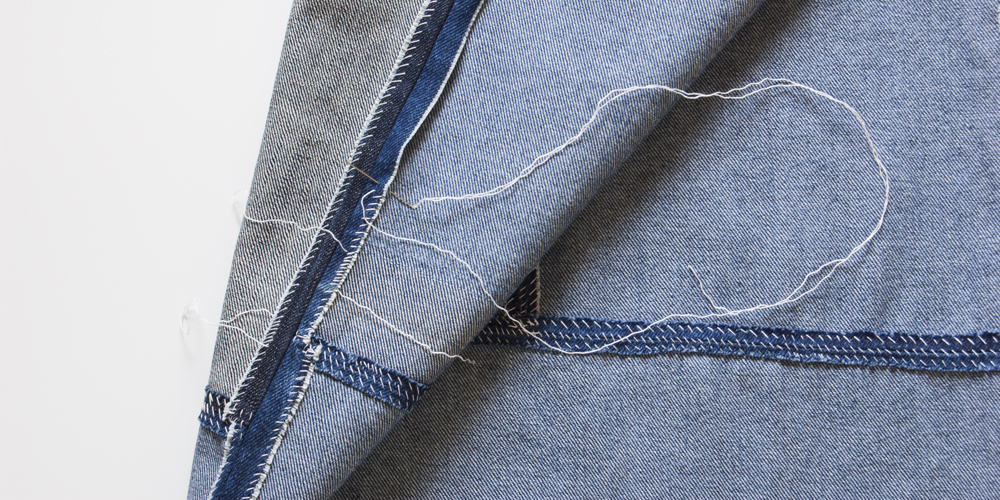
This tote bag is about as simple as it gets. And believe me when I say that I demonstrated much restraint in over-embellishing it with excessive ideas. With this project, I wanted to try a few things, but not to the point where I over thought the design of something so simple. As with my previous denim patchwork project (my apron), I use a running stitch to patch right sides together, then a whip stitch to seal edges, and reinforce the seams. However, in that project I was joining three strips of fabric together, where each whip stitch seam was parallel to each other. This time, I wanted to see how this technique would translate to the perpendicularity of intersecting seams. Would it be too thick? Will there be structural weakness? Can I even do this correctly?


Okay, well that last question doesn't even apply. I just do what works, and I needed to do this in order to find out. In addition to the intersecting seams, there was this issue with the bottom of the bag. I knew I wanted it to look and fold like a paper bag, but didn't really know how it would come together until I actually did it. It wasn't hard, I just looked at how a brown paper bag is constructed, and went from there.

Ironing was something I did a lot of throughout the construction of this bag, not just for the whip stitch seams, but also to get the bottom to fold the way I wanted. And when I say 'fold,' I refer to not just the sewing construction, and reinforcement. When the bag is empty, I want it to fold down, much like a paper bag does. So in order to maintain the folds, I whip stitched them into place.


I added the small loop tabs on the edges of the bag for various reasons. Mainly, I wanted to be able to clip them onto the belt loops of my jeans, but they can also be used to reduce the size of the opening, or to secure long, protruding things like flowers or baguettes. Because of this project, I feel more confident with patchwork. It's only the second patchwork project I've done. It's liberating. Now I feel better about chucking some of those reusable bags into the recycling bin.

The denim I used was from two pairs of jeans, each with their own photo essay if you'd like to see them getting recycled, step by step. The lighter blue was recycled from a gigantic pair of Kikwear raver jeans, the darker ones are from Old Navy. The thread was split from a multi-strand yarn recycled from a Façonnable men’s sweater.