Showing posts with label sewing. Show all posts

20160509

These Fragile Things


I’ve been pretty stingy about sharing all the batiks I’ve collected (and inherited) over the years. Somehow I feel like I’m oversharing. You see, these textiles mark a very specific time in my life, and in the life of my mother. She was the one who acquired them all, either by my request, or her whim. When she died, I claimed as many of them that I could find. There were many more than what I ended up with. I remember specific ikats that are just lost or unaccounted for. I don’t know if I can explain in words how that makes me feel. But then that would be oversharing, according to me, right?


So this bandanna is another salvage project from one of the batik tablecloths that my mother didn’t take very good care of. Let me back up: my family hail from the island of Guam. If you’ve ever been to the South Pacific region, you’d know about the intense humidity that hits you like a wall once you step off the plane. That humidity also affects many other things like computers, and stereos, and well, fabric. So this increased moisture ultimately affects the stability of cottons, especially in this case where the table cloth is in contact with the edges of a table, hence the rips.


After cutting them out, I looked at what I could do with the fabric, and since I made a long scarf out of the last one, I decided to cut a bandanna out of it. There’s not really much to it. I spent more time measuring, cutting and ironing than actual hand sewing. My penchant for whip stitching is present here, another characteristic technique I learned from my mom. She showed me how to hem pants when I was young, so it was the first stitch I ever learned.


I suppose it’s something of an overreaction on my part to say that sharing these textiles is oversharing. I know. I guess what I’m trying to say is that the meaningfulness of these fragile things is paramount in my thoughts, and that working with them gives me a very private sense of accomplishment and emotion. It is in these projects that I feel I’m truly accomplishing more than what my polished photography can express.


20160301

Balance


One of the issues I ran into with the first recycled denim tote I made was the lack of rigidity in it’s structure. Visually, I like how it turned out, but I felt it was too floppy. There’s this balance that needs to happen between structure and weight that I’m sure a lot of architects would be familiar with. The thinner and lighter the material, the less stress it can withstand. Another secondary issue involved balancing the relationship between aesthetics and function. More embellishment means more weight and structure, but consequently it also means the bag itself will be heavier.

That first bag went in the direction of lightness, with minimal patchwork and embellishment. But with this one, I pushed a little further into a heavier composition of patchwork that wouldn’t be so floppy. There are of course other ways of approaching the structure issue such as adding thin interior pockets for paper/card stock inserts, or even using starch. My interest in raw denim lead me to that starching idea, I should try it some time.

Looking at various constructions for tote bags lead me to the conclusion that the structure is achieved in two parts. The first is the folded over stage in which the strip(s) of material are formed into a flat, enclosed shape. In the second stage, the bottom is pleated to achieve a three dimensional form. From a design perspective, this was quite liberating. Regardless of how you achieve that first flat stage, the pleating of the second stage will always add structure. So I took a cue from Japanese design, specifically from sakabukuro bags which consist of long strips of fabric, spiral seamed into these fantastic diagonal forms. Some of you may remember I’ve used this technique before on a woven scarf called Delete C.


There was a good amount of measurement I had to do before hand, but it all worked out, and my math proved to be sound. Basically what I needed was a long strip of fabric, and I happened to have a composition that fit the exact width in my calculations. As the weeks went by, that length of patchwork denim grew longer until I had reached the required length.


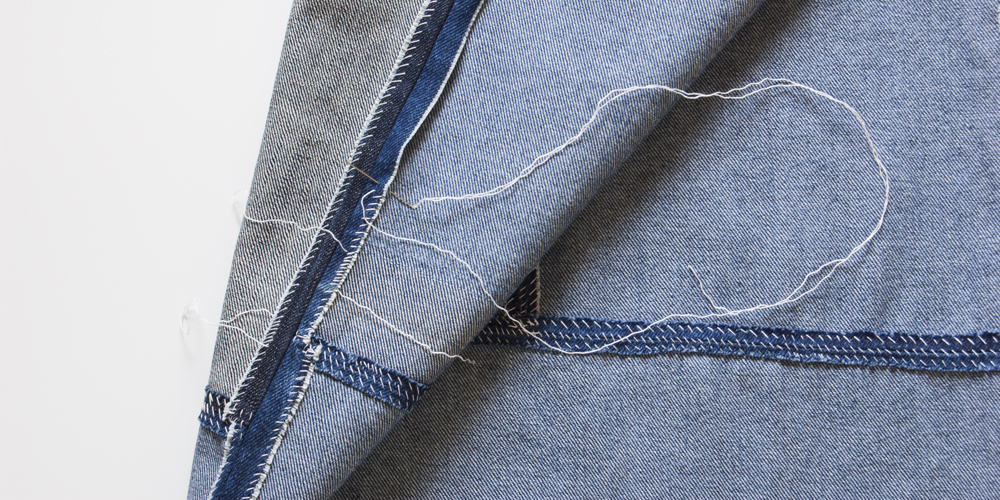
This particular spiral seam consists of an alignment between the center point of the fabric and the center point of the hypotenuse of a 45 degree fold. The fabric is then folded perpendicularly to the hypotenuse until it runs out at the top. I had been working overlapping seams during the patchwork process, so I employed them here on the spiral seam as well. This altered my calculations a bit, but not by much. The hypotenuse of the initial fold then had to be pleated to make the flat ‘foot’ of the bag. I did this on the inside, sewing down the resulting right triangles to get those nice sharp corners.


By the time I got to the handles, I was basically winging it. I didn’t have a plan to deal with those peaks at the top of the bag. Initially, I just wanted to conceal them by folding them inward. Playing with that idea a bit, I decided to fold them in only half way, leaving a nice angular opening on either sides of the folds, but also doubling the fabric where the handles would be sewn in.


When it comes down to it, yes. This tote is more rigid than the last one I made, so in that regard, the goal has been met. I think I can push it further, but the issue isn’t necessarily with the structure, it's with the materials. Denim—especially recycled denim—is broken in, and inherently floppy. That’s it’s charm, but also it’s disqualifier. If I truly want to create rigid structure, what I need to be working with is leather. A patchwork sakabukuro style leather tote. Wouldn’t that be awesome?

Fiber Credits:
Darker denim: Old Navy
Lighter denim: Kikwear
Navy thread: Banana Republic
White thread: Façonnable

20151028

To Remember


Something I don’t share very often is my modest collection of batik textiles. They date back to a short span of years between the late eighties, and early nineties. I know this because they belonged to my mother, and that was the timeframe in which she visited Bali and Java. I guess I don’t share these pieces because I’m reluctant to chop them up. That’s pretty much what I’m doing most of the time: I dismantle things, and make new things out of the pieces.


This particular batik fabric was once an oval table cloth. After my mother died, I asked my father to send me her Balinese textiles, and this tablecloth was one of them. Mom liked these things as much as I do, but apparently she was never good at taking care of them. The damage indicated that it was left on the table for a really long time until the table corners ripped through the fabric. I figured this was a good opportunity as any to harvest this fabric, and make something new.

I like long scarves. I’m sure many of you know that by now. Most of the pieces I’ve designed have been in the range of eight to ten feet. Visually, I’m drawn to this aesthetic. I like thinner, finer fabrics with lot’s of area. If I want it thicker, I can wrap it around twice or even three times.


All together there are six pieces in this patchwork, seamed together with running stitches, then triple whip stitched. There was a lot of ironing and measuring involved. You may have noticed that I leave the raw edges. I like them. In time they will fray, but the whip stitching holds things in place. Something else I did was orient the folds of the seams so that verticals sat on one side, and horizontals sat on the other. Again, this was just me celebrating those raw edges. All together, this piece measures 20in (50cm) wide by 108in (274cm) long.

I never saw this table cloth on the kitchen table in our house on Guam. I wasn’t living on the island anymore at that point, I was here in California. But this piece let’s me be there on that hot little island in the Pacific. There were plants everywhere, and a beach down the street, and humidity that would eat your table linens alive.


20151019

Take the Time


I think a common misconception about my photography is that I make tutorials. Although these photo essays can be seen that way, that's not really my intention. What I'm doing is sharing my creative process in order to help you develop yours. Explicitly telling you step by step how to make something doesn't really help you do that. And let's face it: creative people don't really need to be told how to do anything. They just need to see that it can be done.

I've had quite a few of these small drawstring bags over the years, but I didn't start really using them until I started knitting. These smaller sizes have come in handy the most since I tend to knit hats. They also come in handy when I need to make room in my backpack. I keep a lightweight jacket in there, and if I need the room, I can stuff it into one of these and clip it somewhere.


The basic design is based on common plastic bags which are banned here in San Jose. The bottom consists of an accordion fold that is sealed together on the sides so that it can open and stand upright. The rigidity of this recycled denim paired with the small size allows this bag to do that whether it is empty or full.


Once again I've used this natural white mercerized cotton recycled from a Façonnable sweater. This is the same thread I split down from a triple strand yarn, and used to make my apron and a tote bag. I've doubled it up to seal the drawstring tunnel, and along the side seams where all the structural strength is needed. The whip stitching was done in single strand to keep the edges as smooth and flush to the fabric as possible. I might add to them later. I like that visual variance between the single and double threading. Maybe that's something I can take into the next recycled denim project.


In the Internet Age, we don't need all that step-by-step. We don't need patterns that tell us what to do. Technical craftsmanship is fully searchable now. There's no reason to get hung up on that. Just focus on what you want to make, and just make it. That journey of figuring things out is part of your individual creative process. Take the time to embrace it.


20150430

Try New Things


As some of you may know already, I live in San Jose, California, and we have a plastic bag ban here. I won't get into why I think that's awesome, but it is. But one thing I noticed is how un-awesome the reusable bags I've collected are. They're terrible. And what's more: the growing collection of them is rivaling the previous collection of plastic bags they replaced. When it comes down to it, I only really need a few reusable bags. I never buy more than a few items when I go to the grocery store because I prefer to go more often. It's an opportunity to ride my bike more often, and I like riding my bike.

This tote bag is about as simple as it gets. And believe me when I say that I demonstrated much restraint in over-embellishing it with excessive ideas. With this project, I wanted to try a few things, but not to the point where I over thought the design of something so simple. As with my previous denim patchwork project (my apron), I use a running stitch to patch right sides together, then a whip stitch to seal edges, and reinforce the seams. However, in that project I was joining three strips of fabric together, where each whip stitch seam was parallel to each other. This time, I wanted to see how this technique would translate to the perpendicularity of intersecting seams. Would it be too thick? Will there be structural weakness? Can I even do this correctly?


Okay, well that last question doesn't even apply. I just do what works, and I needed to do this in order to find out. In addition to the intersecting seams, there was this issue with the bottom of the bag. I knew I wanted it to look and fold like a paper bag, but didn't really know how it would come together until I actually did it. It wasn't hard, I just looked at how a brown paper bag is constructed, and went from there.

Ironing was something I did a lot of throughout the construction of this bag, not just for the whip stitch seams, but also to get the bottom to fold the way I wanted. And when I say 'fold,' I refer to not just the sewing construction, and reinforcement. When the bag is empty, I want it to fold down, much like a paper bag does. So in order to maintain the folds, I whip stitched them into place.


I added the small loop tabs on the edges of the bag for various reasons. Mainly, I wanted to be able to clip them onto the belt loops of my jeans, but they can also be used to reduce the size of the opening, or to secure long, protruding things like flowers or baguettes. Because of this project, I feel more confident with patchwork. It's only the second patchwork project I've done. It's liberating. Now I feel better about chucking some of those reusable bags into the recycling bin.

The denim I used was from two pairs of jeans, each with their own photo essay if you'd like to see them getting recycled, step by step. The lighter blue was recycled from a gigantic pair of Kikwear raver jeans, the darker ones are from Old Navy. The thread was split from a multi-strand yarn recycled from a Façonnable men’s sweater.


20140630

Worth Doing


My studio has been a mess lately because of this apron. Now that it's finished, I can get back to the other stuff that got back-burnered because I got a sudden urge to use up all this denim I recycled.


If you've been keeping up with me on Facebook, or more recently on Instagram, then you've seen all the in-progress images that I've been posting. There are a few you haven't seen, though. Namely the sashiko section I used to stabilize the lower hem. I've been pinning some images while researching Sashiko technique, and have found more decorative demonstrations than reinforcement stitching which is what I've tried to do here. I say "tried" because despite the gathering tendencies of spiral stitch, the edge still curls slightly. I think I'm just going to leave it curled. I plan on adding more stitching to other areas, but I want to get a few washings in first, and see how things develop.


The white thread is a 100% cotton recycled from a Façonnable men's sweater, and the black is a 100% silk recycled from a Banana Republic women's sweater. You may notice from those images that each garment was knit with a multi-strand structured yarn, so I had to separate each strand to use the thread individually.

This project was pretty hard. I could have used my sewing machine, but the beauty of hand stitching cannot be denied. And if you don't know me by now, then yes: I do hard things. They're worth doing. Now I think I'm going to clean up my workspace.


20140513

Just Make


So that denim I showed you the other day was sitting around within my field of vision the past week because I wanted to sew something out if it.

I don't know what to call this, but I'm currently using it as a mouse pad. The physical parameters indicate that it's a bag. That's fine. If I feel like sliding a piece of paper into it with web passwords, then so be it. If I want to use it as a divider inside another bag, fine. There's no specified purpose for this object. Making it was far more interesting to me.


Measure, cut, iron, stitch. It's like a creative meditation.